Episode Transcript
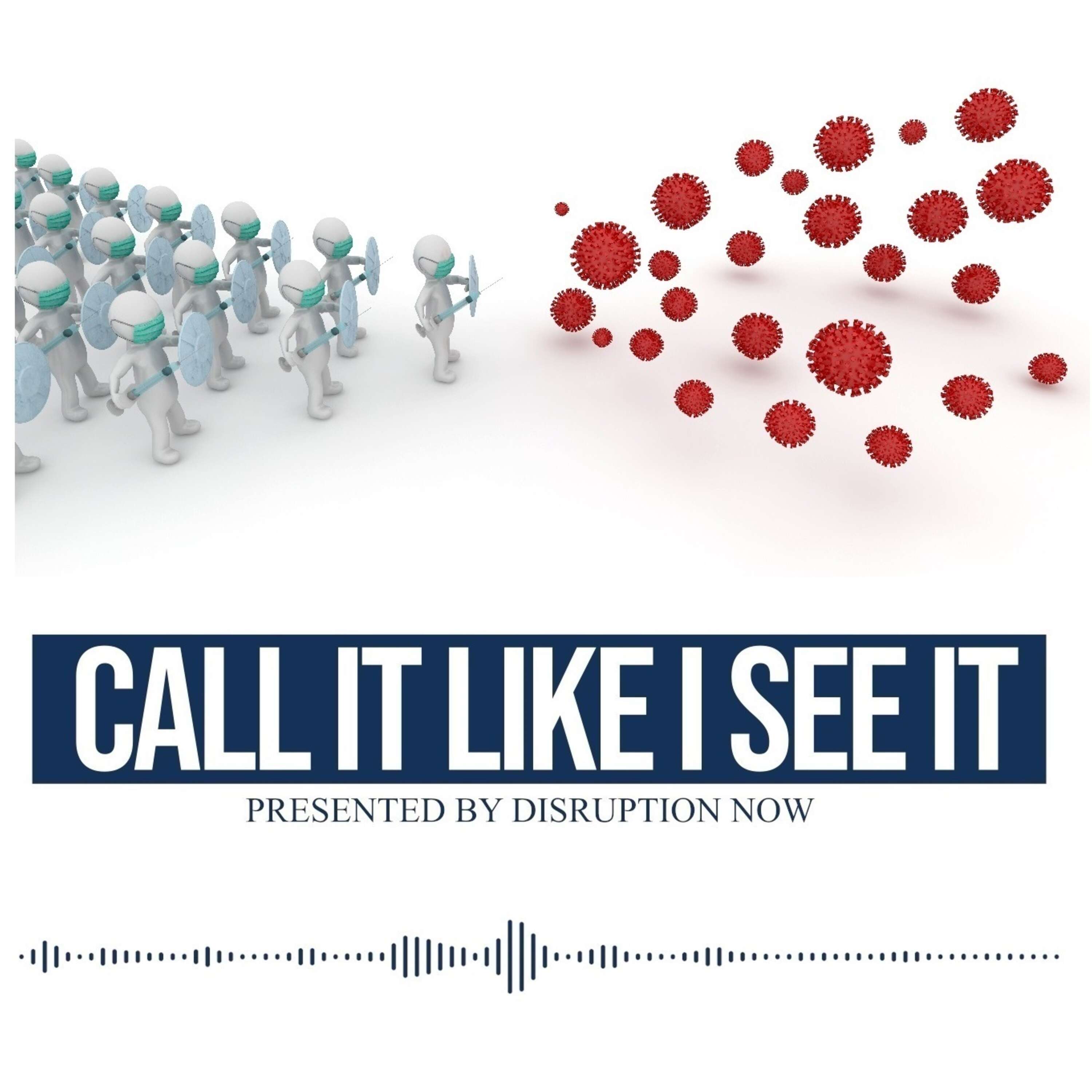
[00:00:14] Speaker A: Hello, welcome to Call It Like I See it, presented by Disruption Now, I'm James Keys, and in this episode of Call It Like I See it, we're going to discuss the recent spike in COVID 19 in countries around the world and the apparent desire amongst some to not give in to the scientists.
We'll also take a look at how far people will go to not have to say goodbye to their pets and in fact, will turn to scientists in that scenario.
Joining me today is a man whose ability to drop deep thoughts and look at the big picture at the same time can leave an ordinary person disoriented. Tunde. Ogunlana Tunde. You're gonna try not to spin us around too much today. All right?
[00:00:58] Speaker B: What'd you say?
[00:00:59] Speaker A: Say that again.
[00:01:00] Speaker B: What'd you say? Where am I? What time is it? What day of the week is it?
[00:01:04] Speaker A: Yeah, okay. Yeah, so you got me already, man.
All right, so we're recording this on November 2, 2020. And while it seems we've been dealing with COVID 19 forever at this point, and everything is just the same every day, we took note that at the end of October, we were actually breaking records as far as the number of reported new cases in a day.
We also see that the leadership in countries in Europe and around the world and other areas of the world, Australia, responding to spikes and infections and going back into lockdowns. So to get straight to it, Tunde, what's your reaction to seeing these rates spike and these reactions by governments? Governments that are reacting to actually what's going on? Like, seeing all this, man, we're back where we were in April.
[00:01:50] Speaker B: Yeah.
Seeing it all is not a surprise to me, actually.
And I don't say that with any judgment. It's just from the beginning, I kind of believe I understood the nature of a pathogen and a virus. And it stands to reason that after the summer months and also with, like you said, all these nations having, you know, kind of opened up and like we did, and people moving around and traveling and all that, it stands to reason that the number of cases would then pick back up. So I'm not that surprised, actually.
I never thought this would be an easy fix one way or another, you know? And I think it proved what I felt in my gut from the start of this thing, that everybody has opinions and everybody thinks that they just want to latch onto some way. And no one likes this, and I don't like it either. Meaning we're looking for easy answers and an easy way out.
And at every turn, there doesn't seem to be one. And I think that is the lesson that I kind of realized from early on. This is a virus. This is not politics, is not a joke and it's not a game. It's just a virus that unfortunately affects the human system in a negative way. And I think this is going to be a few years. So I could see. And I guess my final thought before just letting you move on with the next question is because from the beginning,
[00:03:15] Speaker A: well, you know, I'm going to respond too.
[00:03:19] Speaker B: You're not only the host,
[00:03:22] Speaker A: it's your world, man.
[00:03:25] Speaker B: No, but what do you call it? The, you know, looking at the models from the beginning, Sweden and Italy, I always felt those were the two good examples that because people that thought lockdowns were crazy and all that, you know, latched onto the Swedish model and the people that thought that that was crazy and the herd immunity crowd was crazy, latched onto the Italy model of the straight shutdowns. And I kind of watched both of those countries over the first few months and it seems to me neither of them work perfectly. So I kind of took that attitude. I was like, okay, well if the lockdown guys, it's not perfect and it's not stopping it totally. And if the herd immunity folks is not perfect and is not stopping it, then nothing is going to stop this from spreading. And I recognize too that there are downsides with full, full shutdowns, you know, that are outside of just the virus part, but there's other downsides to it. So I don't think, I mean, it's
[00:04:20] Speaker A: going to be easy.
[00:04:21] Speaker B: And that's why I'm not surprised. Like I'm just not surprised that this sucks. And that is more bad news.
[00:04:26] Speaker A: It strikes me that yes, there are. There does not seem to be a easy or direct solution.
We all seem to be. And maybe this is just for psychological well being seem to be waiting for another shoe to drop that will make this thing go away. Or even if you're saying if you're in favor of lockdowns and so forth, the point of the lockdown is to cut the spread of it. So hopefully it would.
They have to spread. The virus has to continue to spread in order to stay around.
That's what viruses have to do. So conceivably, if you lock down well enough, then you can stop it in its tracks. But that's not really happening even when you do. And then part of it also is just we have, it's a big world, you know, like it can recede in certain areas and then pop back up. I know, like in New Zealand they had no cases for a while and then, you know, one pops up, you know, and because it's a big world, like, no, even if you control it in your one country, you can't control it necessarily with people going from country to country or things like that. And so, yeah, that's what it seems like now. I was more optimistic. I thought that if we could, if we would been able to lock down sufficiently, that maybe there was a chance that especially over the summer months, that the virus would not be able to spread enough to maintain its potency to be active anymore. Obviously that didn't come to pass. But even in the areas where they did lock down well enough, it didn't seem like they didn't get rid of it completely. They just managed it better.
So, yeah, that's what stands out to me here is just that there do not seem to be answers that anyone will be satisfied with. As far as what we can do here, you know, we're either going to overwhelm our system and let a lot of people die or we're going to do what's uncomfortable. There's fatigue amongst everyone amongst dealing with this. One of the things I saw with these lockdowns is people are protesting. It's not just in the U.S. you know, people are protesting lockdowns all over the world. Like, you know, this is. And so there's pain no matter what direction we face.
Now, I don't think that that means you put your head in the sand, but at the same time, this is just where you need good leadership. You need leadership with a clear vision, leadership to try to lessen the pain that everyone inevitably goes through. And you hope that wherever you live you have that. And if you don't, you hope that you can get to a better place or you try to maintain as you can.
[00:06:54] Speaker B: Yeah, I mean, I'll say this too is just, I think, you know, like you said, we need good leadership in general. And I think when I say we, I just mean humanity. Right?
[00:07:02] Speaker A: Yeah, humanity, yeah.
[00:07:03] Speaker B: It's picking on a country or anything like that. It's just, you know, let's hope that we have good global leadership, you know, and kind of the big movers of the world, you know, kind of do the right thing and whatever that means. But I do think also we need some maturity at the ground level, you know, meaning us, the populations.
And that's kind of what I mean. Like, I don't like this either. I don't like being stuck in my House for so long. I don't like that. You know, my kid has an autoimmune issue, so we're very careful with this.
I don't like, you know, any of it, but I'm also just mature enough to understand, okay, this is a virus and it's new to humanity and it's going to take some time for us to figure it out, blah, blah, blah, blah, blah. Right. And I just feel like, you know, everybody needs to chill out and stop looking for these not, you know, like you said, the kind of secret potion like that's going to just be a cure all, forever, all of it. And also stop like picking and bashing on what they perceive as the, their, I guess, ideological opponent on whatever they think should be, you know, whatever they.
[00:08:09] Speaker A: Well, people are using it. Yeah. Opportunities.
[00:08:11] Speaker B: Yeah. Should not be the way. So for example, like you said about New Zealand, you know, they did a great job containing the case early on and all that and now somehow they got some cases right.
So, you know, the people who don't like lockdowns now point to that and kind of laugh. Haha. Look, you know, even with all their strict measures and all that, they got it spread there and you know, that's, you know, we shouldn't be gloating about that. And on the flip side too, right, like the Swedish model doesn't appear that it worked out so well and a lot of Swedish people, they had a higher mortality rate and all that and that's not.
But at the end of the day, the people that were all about lockdowns and thought that the herd immunity ideas were stupid also shouldn't be sitting there making fun of Sweden. I mean, my point is, is that this is new. Everybody's trying something a little bit different and you know, instead of always want to poke it in somebody's eye, we all just need to chill out, let these experts do their work and know that it's going to take some time and be okay with that.
[00:09:11] Speaker A: Yeah, yeah, we're all sitting in glass houses.
But you bring up the expert thing. And that was something actually that really stood out to me this week. Or like I said it was last week when I read that in the uk part of the objection with Boris Johnson implementing a lockdown was the objection from his own party, from his own Conservative Party, was that he was giving in to the scientific advisors, which I just didn't. I wonder if that's really the underlying theme of where we see a lot of resistance to, to issues where the answer that's coming from Medicine or from science is one that we just don't like. And so therefore we make science our enemy or make scientific advisors, people who are, I mean, again, and science is supposed to be. Now, it's not always, but science is supposed to be about not matters of faith. Basically, we're not going to just believe it because we want to believe it, but we're going to look at it, we're going to test it, see if it works. If it doesn't work, then we'll try something else. If it does work, then we'll go with it. That's the nature of what science is supposed to be. So what did you, what's your feeling or what's your thought on? We see this hostility towards science and really summed up in not giving in to scientists. Specifically with COVID we can, we can broaden it out. But specifically with COVID in this case where Boris Johnson's catching heat, literally, and I quote, for giving in to his scientific advisors.
[00:10:36] Speaker B: Yeah, no, I mean, look to me as a guy that believes in, you know, evidence based fact and that kind of stuff and rational thinking, I mean, it's sad to see that through all these hundreds of years of scientific achievement and all the ways that our society on a daily level, including you and I doing a podcast over Zoom, you know, with a satellite that's connecting us right now in real time. You know, the idea that science isn't important is laughable in today's day and age. But you know, on a serious note, this is a reflection of, you know, again, the human experience of irrationality. So my first answer would be this is another example of killing the messenger. Right? We don't like this.
[00:11:18] Speaker A: No, exactly.
[00:11:19] Speaker B: This is annoying. This is sucks that we gotta, you know, change our lifestyle. We can't go to bars, we can't hang out, we're being told what to do, told to wear a mask. My kids are, you know, school's messed up, blah, blah, blah, blah, blah, right.
So I can't really concentrate my firepower anyway and my emotional energy.
So I guess who are the ones that I'm going to concentrate it on? Is the messenger, the one that's telling me how bad it is and that I got to do these things.
I just think it's fascinating, man, because, you know, we're at this time. That's what I mean. We're at a time where we can't deny science impact in our lives every day. I mean, yeah, you know, whether it's our medicines we take, whether it's like, I Said we're on the Internet right now talking to each other.
[00:12:00] Speaker A: Or just go into the refrigerator. Or just go into the refrigerator. Or just like getting in a car.
[00:12:06] Speaker B: Yeah. And that's kind of where I felt too. And just reading, preparing for our discussion here was like, I think that's the problem that science will always have, has had in the past and will always have in the future. And it goes back to the old Mark Twain joke that we said about a lot of topics. Right? That a lie can get halfway around the world before the truth can even get its shoes on. And the problem is, is that the very definition of science means that there's been fact based evidentiary research to either prove or disprove something.
[00:12:40] Speaker A: Yes.
[00:12:40] Speaker B: You know, that the science is looking at.
So inevitably when you have again, we've said it before, a novel, not a book, but novel being a new novel virus, novel coronavirus and something that's new to the human body and the human condition is naturally going to take time for the scientific and medical community to do the testing that's needed. Like remember.
[00:13:04] Speaker A: And even more so hold on then let me just jump in real quick. And even more so, part of that time is going to be spent with them getting it wrong, learning from that and then moving to something else. But if you want to just harp on and say, oh, you guys said this and now you're saying something else, it's like, well, yeah, that's the scientific method. Like you try something and then if it doesn't work, you try something else. You don't just stick with the same thing even though you see it doesn't work. Which is more so like a matter of faith. If you do that and we all
[00:13:32] Speaker B: learn about these things. Thomas Edison, 10,000 tries to get the right filament for the light bulb.
What if he stopped at the 9337th time because someone kept telling him he's an idiot? I'm just saying that that's what I meant when I said earlier that we as a population also have responsibility to chill out and let this stuff play out in a certain way. Because the fact that this is a new virus means that the scientific and medical community, they need time to get it right because they're going to get it wrong.
[00:14:05] Speaker A: And that's why the thing is also that throwing a temper tantrum doesn't make you, doesn't get you any closer to any type of workable solution either.
[00:14:12] Speaker B: Oh, for sure.
[00:14:13] Speaker A: Well, let me jump in also though, because there was a point I wanted to make. I Think that one of the things that we have to keep in mind here is that there is an underlying human element here that I think is present across the board. And that is that there are like two competing mindsets as far as how we're supposed to interact with nature.
You know, there's the mindset of that we as humans should understand and harness nature.
But then there's also the converse to that which would be, which is present in humans also is the mindset that we need to dominate and impose our will on nature and part. I think you can see that in terms of how people perceive the coronavirus sometimes or how people perceive science's role in dealing with the coronavirus.
If science's role is to dominate the coronavirus, to impose our will on it, then we should have a vaccine right away. And we need to push the scientists to say, hey, you need to get this, to grab this thing by the horns and, and make it do what we want it to do versus the other mindset, which is more so to understand and harness it, which takes longer. It takes longer to understand something. It takes longer to figure out maybe the best way to extract something from the earth that doesn't necessarily throw everything off than it does to just blow the top off with, you know, with dynamite and just grab it. And so the understand and harness mindset may be a more patient mindset when you're dealing with natural phenomenon that, that you're expressing, saying, hey, we need to chill out, but people whose mindset. And again, I think this is hardwiring mindset, like these things can be mitigated a little bit just in terms of the type of leadership, the type of messages you get. But I think this stuff is kind of hardwired. People who are hardwired want to dominate nature.
There is no space or no time for understanding and to try to be patient for this, we need to dominate this thing as of yesterday. And so I think that you see that as well. Like, that's what really what struck me about this comment is just to say giving in to the scientists, because the scientists, they're the pocket protector guys that are trying to learn about all this stuff. And we don't need to learn about this. We just need to do what we want to do.
It's kind of the mentality I took from that. And I think, like I said, I think there's a human thing to that. And you look back throughout history, there's been all, you know, like there's always that, that conflict, so to speak, within humanity as Far as how we're supposed to interact with our surroundings.
[00:16:44] Speaker B: Yeah, no, I think, I think, you know, you're right. I'm not. There's nothing I can take away from that point. I would say I would add to that, because you're right. What I'm about to add might bring up more of that type of mindset out there in the population is you add to it misinformation, intentional or unintentional. Right. Some people do unintentionally spread misinformation. You know, they hear something, they either misheard it, or they take it as fact. And they generally want to get the word out and they spread it.
[00:17:16] Speaker A: And it might be misinformed to add to it. So therefore, if you're inclined to. If you're the mindset that's inclined to want to dominate nature, then misinformation that satisfies that urge for you, you would be more prone to, To. To jumping on and running with it, basically. Like you're already wired to want that message, you know, regardless of what it.
[00:17:40] Speaker B: So.
[00:17:40] Speaker A: And people know that. People know that. They can. They can feed you that.
[00:17:43] Speaker B: No.
[00:17:43] Speaker C: And then.
[00:17:44] Speaker B: Yeah, and the other one that. The people that feed it. That's what I was going to say. That's the second group are the ones that maliciously spread this information.
[00:17:51] Speaker A: Well, but that's what I think that the political aspect of this is less interesting than the human aspect of this. Because think about it like this. Also like. And in terms of how we react to the threat of illness, people are very different.
Everybody doesn't react to the threat of illness the same thing. We all knew people like, when we grew up, it was AIDS and all the STD type stuff that was a really big thing. AIDS was new. Magic Johnson was 91, 1991. And so in the 90s, that was all big. It's not like everybody in the world practiced safe sex after that point. Like, people were all over the map doing different things. And not everybody responds in the same way to the threat of illness. And so you build that. So like I said, I think the political stuff, it may be shiny in terms of what people talk about all the time, but I think there's a lot of human stuff with this virus stuff that really is more interesting. And there's more to get from it too, because if you have. If already, forget the coronavirus, but just say illness in general or viruses and things like that, and you already have a spectrum where certain people are just not going to view that risk as enough to stop them from doing what they want to do. And then you have other people that would view any risk as something that they need to take seriously and they're going to alter their life for. It's risk tolerance. That's risk tolerance that exists in business, that exists in a lot of things, but it also exists in terms of how we feel, what we feel about the threat of illness and viruses and bacteria and things like that. And so you put that on top of, then you build that on top of, you know, all of the geopolitical stuff that's going on. And then also the national politics and regional politics and all that. That's when you get this thing where everybody's pointing fingers at everybody else. But actually this is just our humanity playing out. Like it makes perfect sense that 30 or 40% of the people look at the virus like eh, what 1%, I'll die, I'm good with that, I'll live with that. That makes sense to me based on what I've seen as far as how people, you know, people don't even wash their hands before they eat, you know what I'm saying? So like, it's not the craziest thing to think of to see that people will look at something like this and say, hey, I don't think this is that big of a deal. Or other people would say, well, hey, I just don't see. There's no pro, so I don't see about taking the risk because there's nothing I get out of taking the risk. And so people are gonna be all over the map anyway. That's where leadership can be very helpful though, because these are the type of scenarios where you do need more of a community purpose or a state purpose or a national purpose. And, and if our purpose as a community is to just be anti another community, or if our purpose as a state or a nation is to just be anti other members of our state or our nation, then we can't solve problems collectively. And so that's really when you get into like the politics part, where you get into that is that these natural hard wiring things of the way we view the world, when those things are weaponized in a way that prevent us from coming together to solve problems, that's where the politics comes in. But before you get to that, you just have a lot of humanity to try to wade through and figure out how to even talk to people, to even find, well, what would be a message that someone who is very risk tolerant, what you could give them as far as the coronavirus, as far as what to do?
[00:21:13] Speaker B: Well, I think the problem we have, specifically us here in the United States, I don't know about the UK and some of these other countries, but because obviously I live here, I understand our culture is this comes at a time, I'd say after a decade of conspiracy kind of being accepted more as fact. I mean, remember we had a guy. I remember the whole famous thing with the pizzeria dude, right, in 2016, that went and shot the hole in a pizzeria because Hillary Clinton was molesting kids. And we thought that was crazy.
[00:21:46] Speaker A: Can I add something real quick, though? Like, we're at a time. It's not just conspiracy. It's conspiracy without any substantiation. Like, you can throw a conspiracy up and you don't have to substantiate it all. Like, even with. When you go back to Obama's birtherism or the pizzeria thing, the pizzeria. This guy went searching for a pizzeria, this pizzeria. And there's supposed to be things going on in the basement. And. And the building didn't have a basement. Or with Obama, like, there was evidence there that they was calling this into question. Somebody just decided that they're gonna throw this out there and people would run with it with no evidence whatsoever. So that's really the thing, because if you're willing to believe anything without seeing any proof, then that. Well, that's where we are now is basically like, people are so distrustful of. And we talked about this a few months back where it's like, we. Why are people so distrustful of a story, let's say the official story, which may or may not have a certain level of evidence behind it. They'll be so distrustful of that, but they'll believe anything. As far as a conspiracy theory, like, it doesn't even have to be rational. It doesn't have to have any evidence. But as long as it's not, the virtue in the conspiracy theory is only that it's not the official story.
[00:23:00] Speaker B: And so remember, it's the messenger has been killed and their body has been burned for a long time, meaning the idea of the government, or, you know, here in the United States. That's what I mean. Being a trusted source of information has already been taken away from the average American's mindset in this era. Right?
[00:23:21] Speaker A: No, I understand that.
I'm fine with being distrustful of government. I'm saying, why would I be distrustful of government and then believe anything some anonymous dude says? Why would I believe everything he Says if I'm distrustful of the government, like why would I not be distrustful of both of them? But, but no, go ahead.
[00:23:36] Speaker B: I just don't like the first letter of your name is a Q and you're anonymous. And of course, you know, you're very believable, you know, and, and so anyway.
But I digress. So no, but that's really my point is getting at is that this, we're coming at a time, this pandemic hit us at a time when at least in our country, our population was already primed to believe in conspiracy. And this is where this is even beyond politics. I mean, and you've heard me rail against this, the fact that the History Channel has a show called Ancient Aliens as if it's legitimate fact that aliens built the pyramids and all that. I mean, it's just a joke. So. And that's what I mean is this is it's been more than 10 years because stuff like that's been on for longer. So our population is already, you know, this whole thing, I mean people that think the moon landing was fake or whatever.
[00:24:26] Speaker A: So we know that conspiracy without any proof, not like there's evidence that there's.
[00:24:32] Speaker B: But remember too, it's about killing the messenger. So that's why I think, you know, I guess to get back to your. The very first question you asked me and what that's why I answered. I'm not surprised that this, because this is understandable that populations are frustrated and that people, you know, I guess not everyone takes science maybe in the way I do and looking at it and giving it time and understanding that, you know, takes time to deal with these things.
[00:24:59] Speaker A: And my point also was that not everybody, not everybody views disease as requiring the same level of seriousness as you may either, you know, so. And that when we're in a big group, that is going to matter in terms of the risk people are willing to take and because those, the risk they're willing to take, obviously with something like Covid affects you, you know, versus if it's something like std, the risk somebody else takes unless you're intimate with them, that doesn't really affect you to the same degree. So it's something we all got to share.
[00:25:27] Speaker B: One of the things before, because I know is there's a couple of things that I thought about the human element and just thinking about this stuff is one is, I mean I was looking at we have around 230,000 people dead in the United States since, you know, let's say late February, whenever They started counting.
I think we had 100,000 in one day. Get the virus, the record for us.
[00:25:50] Speaker A: Yeah.
[00:25:50] Speaker B: I just was thinking like it's funny how we, you're right. About not just disease but how we respond to all these different threats. Yeah. And then how like how our media also drives us and the consumers of said media get driven to different things. So I have people right now in my life mostly that are over 60 that watch more of the, you know, let's say central or left leaning media and some of them won't leave their house still eight, nine months later, they're so freaked out about getting sick and catching this thing. But then I was thinking, it's funny because the friends of mine and the people in my life that watch more of the conservative media like the Fox News and all that, they seem to be less, you know, concerned about not wearing masks and being out. So it's interesting about the media that we consume drives our behavior and how we react to certain fears and well,
[00:26:47] Speaker A: it could be reversed though. I don't know that that's a chicken
[00:26:49] Speaker B: egg thing but, but, but, but it also determines how we look at the messengers. Right. Because then each side looks at the other one's media as not, not, not accurate or not true or something they can't accept.
[00:27:01] Speaker C: So.
[00:27:01] Speaker A: Well, no, but what I was saying though is that, remember there's self sorting that goes on.
Media you consume is your choice. And so it may be, it may not be that the media that you choose to watch drives that kind of behavior. It may be the kind of person you are drives the kind of media you consume. Well, let me finish the point.
[00:27:20] Speaker B: Yeah.
[00:27:20] Speaker A: And the kind of person you are drives the kind of media you consume. And then you end up in that place that like that person who's staying at home who watches a centrist media, you know, corporate, just basic general corporate media, CNN or something like that, that person, like that person may be inclined to stay home anyway and may be inclined to look at the world in more that way. And that's why they watch CNN and that's why they stay home versus someone who may watch, you know, a right wing media and be more inclined to want to say no, I'm going to do what I want, forget what this virus says. And you know, so I don't know that you can say that the media is driving people apart. It could be people self select their media. People's media isn't chosen for them.
[00:28:01] Speaker C: Here's why I say what I said
[00:28:02] Speaker B: because it made me think about something like ISIS.
And remember 2013, 2014, 2015, when, you know, it was scary and we saw the videos of them chopping people's heads off and all that stuff. Right. And the refugees into Europe from Syria and that whole conflict. And it's funny because I never felt that ISIS was a genuine threat to us here in the US not because I don't think they could. Few rogue guys could do some bad things. And I know that there were some people that did do bad things in our country and said that they were sympathetic to isis. But it's just the idea that again, there's a rat is like Al Qaeda, a ragtag group of guys are not going to take over our country. Right. And there's only so many of them.
[00:28:43] Speaker A: Yeah. And our guys get paid. Our guys get paid to stop that kind of stuff. So it's not like we're just sitting here not doing nothing.
[00:28:49] Speaker B: Yeah, but the reason I just bring it up is because it made me realize that the same people that consumed right wing media seven, eight, nine years ago that were freaking out to me again about isis, oh my God, we can't let any Syrians in this country. We can't do that again.
You know, I was thinking, what's the most Americans that these guys, God forbid, a few of them got in the country, Right. We had the guy in San Bernardino that unfortunately killed 14 people when the shooting spree and said he was representing isis. I think there's been a few others. And every death is terrible.
But I started thinking, you know, this virus has killed 230,000 people in 10 months in this country. That's a lot of people.
[00:29:29] Speaker A: ISIS wasn't doing that.
[00:29:30] Speaker B: ISIS wasn't doing that. And that's what I'm getting at, is that the messenger to me does matter in a sense because people will also believe what they're kind of told to believe in a sense. Right. If they're told that these guys in the Middle east on the other, you know, not the other side of the world, but on the other side of the ocean who by any other means, like you said, don't really have en masse, a way to get over here. Right. There's no land bridge and you got to come here by plane. And like you said, there's a lot of people getting paid right now in the NSA and the CIA and these other agencies. We have to make sure those guys aren't getting on planes en masse and coming here. Not that one or two may not fall through the cracks.
[00:30:09] Speaker A: Yeah. And our guys Are good.
[00:30:11] Speaker B: No, but that's what I'm saying is just I started as I was reading this stuff, I was like, it's interesting how there's a whole section of our country that turns off this threat to which we see it and many of us, because I have friends that, you know, consume that kind of media and I watch it just so I know what's going on. And I know people that have had Covid themselves and don't believe this is real, basically, like they believe it exists, but they think, you know, but it's too much, you know, I don't want to hear about this anymore.
But they're the people that if one guy got killed by somebody named Mohammed somewhere in this country, they're going nuts. Like, we need to shut this country down and da, da, da. So I think part of it is people are believing what they want to believe. But again, that's where leadership's important.
And I think because we have such a fractured consumption of media. And by media, I don't just mean the kind of traditional news when I say that, I just mean social media people getting their news from Facebook.
[00:31:10] Speaker A: Well, no, there's something to what you're saying though. Like there's actually been studies on this and you know, maybe we'll do a show on this sometimes. But what you're shown, the threats you're shown most consistently and warned about most consistently do become most more prevalent in your mind, you do worry about them more. So if you're repeatedly told about some threat, even if it's, you know, 5,000 miles away and you're told about it over and over and over again, then you will be more afraid of that threat than something that may be right next door that you're just not. You said, oh yeah, this is there, but you know, we're not worried about that. And like, so that media can condition you in terms of beyond just the self selection which I speak on, but also media can condition you to react certain ways to threats and react in ways that may not be proportional to the level of risk that you actually face.
And so to bring it back to the virus though, like, yes, if your experience of the virus is by and large defined by what you see in the media, social media, regular media, whatever, which for many of us it is and it's. And whatever you're watching is telling you a message and that's what by and large is your experience, then yeah, you will internalize that more and behave more on that. But again, for me, like, I found it beyond the beyond looking at the political aspects, I think the human aspects of this are just fascinating though. And I think that that's, the virus is gonna be with us for a while. I mean, I think that's clear at this point. And so these human aspects, we need actually our leadership to be able to start to understand these human aspects a little better because national mass mandates aren't going to solve the problem. You know, like it's not going to be necessarily a top down declaration that's going to be, make us be able to find more common purpose here. It's got, you're going to have to want people or you're, excuse me, you're going to have to get people to want to buy in to what the scientists say, you know, and that's going to be difficult. That's not going to all be able to come from one place because trust, as far as who people trust, I thought Rob made an excellent point the other week when we, when we talked about something similar to this was just that people listen to who they trust. And so there's nobody in this country that everybody trusts, you know, and so it's going, the message is going to have to be from a lot of different places, just that we can all try to get on the same page and figure out some type of way to deal with the virus on an ongoing basis where we can keep the economy going, people can keep food in their belly and roofs over their head and we can wait until we can get back to the life that we all want to pick back up from. So, and part of that is going to be trusting scientists, like that's inevitable. I mean scientists, they're going to keep trying to learn more and we need to try keeping, keep trying to be able to benefit from what they're learning from. And I mean, there was one other thing we wanted to touch on a little bit more. It's a little lighter, I guess, to some degree. I mean it could be also be the foretelling of the end of the world.
But speaking of trusting science, this may be a little too much trust. But we saw that there was a person who seemed to be happily giving in to scientists. A woman from Cedar Rapids, Iowa, who we recently saw ordered a clone version of her pet cat from a Texas company. And so like apparently now cloning, you know, they've been doing that, you know, with mammals. I know you have some information on that as far as that goes back over 20 years.
But I mean, how comfortable are you with the thought though that cloning animals now for pets or whatever is a mail order thing now, you know, just mail order clones, you know, type of thing. Like what's going on, man?
Good question.
[00:34:49] Speaker C: I actually am not that comfortable with it, to be honest with you. I find it just fascinating, obviously from a scientific standpoint. But it's weird, man. I've thought about it after reading that article and like you said, I mean, just to go a little bit back, because I thought about the first one I ever heard of was Dolly, that sheep. And just for the audience, you know, I've looked it up. It was 1996, July 6th was that sheep's birthday of 1996. So officially, you know, 24 years ago, basically was the first mammal kind of advanced life form, let's say multicellular kind of thing that, that was cloned successfully. And so since then, and that's what it's kind of fascinating reading that this has become like a cottage industry of companies that do this to your point about like cloning pets and other just animals, dogs, cats, you know, I think they said some reptiles have been cloned, that pet owners, when their pet dies, want to I guess, see still have their pet, the next best thing to their pet around.
And yeah, man, it's weird. I tend to think that when something dies, it dies and we should allow it to pass on whether it's. I know that obviously a clone isn't the same thing as bringing something back from the dead officially, but I feel like it's an example of us as human beings wanting to hang on to something forever and not the ability to accept that things move on and time passes for everything. And so to me, that's why I said I kind of not comfortable with it from the big picture. And then like you said, and just kind of joking coming into this was like, yeah, what does this mean? Because I know that we had that issue with that Chinese scientist a couple of years ago that did the first baby, I think he was, he edited the genes. So I don't know if that's the same as a clone in that way. But you know, at some point this will translate over to humans and it's just like, what does that mean? I just find that interesting if it
[00:36:48] Speaker A: already hasn't, you know, like you said, like you bring up like they're, they're messing with the genes of humans, you know, and then having them be born, you know. But yeah, I mean, and that's me,
[00:36:57] Speaker C: I say this though too, because I don't know what that means, right? Because I say I'm Uncomfortable now, but as you say that, it makes me realize. So I got a son who's got type 1 diabetes.
His pancreas does not produce insulin. I never thought of it until right now when you said that, but what if somebody told me in five, 10 years, hey, we now have the technology that we can clone your son's liver. But we figured out a way to make the protein in the DNA or something when the new one grows, that it will produce insulin. And now when we do that, we can just do a transplant or a liver transplant on your son, and then he'll never have diabetes again. He never got to prick his finger to take blood, and he doesn't have to worry about all this stuff, you know, do I like it then?
You know what I mean? Like, my situational ethics may change. So, you know, is there a place for cloning?
Then? I'll say selfishly, probably, yes. When you look at it, could it be limited to, like, organs and things that help people live a better life that are already alive?
Maybe I could see that. But what I want to. What I think it's right to, let's say, clone my wife if she passed away, or cloned one of my kids? That I just. I mean, that's me now in our society and our culture. Maybe if I was born in a different era, I think differently. But right now, I just think that would be creepy. Honestly, Like, I feel like, okay, if someone dies, they died. Like, I don't want to because it's not really them, right?
[00:38:24] Speaker A: Well, no. Yeah. Once you go into humans, it's different because with a pet, there is ownership. Like, so it's this lady's cat, you know, like, so if you clone. I mean, you wish.
[00:38:36] Speaker B: So I'm doing it esoteric because even
[00:38:37] Speaker C: owning an animal, like, it's a living creature. But also, here's what I was fascinated.
[00:38:41] Speaker A: Let me make the point, though, because, like, you had mentioned cloning your wife, you know, which you volunteered it. So I'll use this example, but, like,
[00:38:49] Speaker C: only after she died. I can't deal with two of them at once. That would be like, imagine like, five of them showing up to bitch at me at once. I'd be like, holy shit.
[00:38:58] Speaker A: Well, what I was gonna say, though, is that the cloned one might not want to have anything to do with you. And then what are you gonna do? Like, it's not like you could say,
[00:39:05] Speaker C: well, no, that's why I might meet five. Right. Cause two of them might not like me at all.
[00:39:10] Speaker A: So, like, with human relationships, is Different. But even with the animals, though, it just. I think with all of these things, like, there is an inherent tension between scientific advancement and then what people may use those advancements for.
For bad. For nefarious purposes or for purposes that would not be good for me or you or society or whoever. And so that's the tension. And that tension is going to be there no matter what. And so on one hand, you say, like you pointed out with your son, you don't want to restrict scientific progress because we're scared. Because we're scared of what someone bad could do. But on this other hand, we. We should be scared about what someone bad could do with some of these technologies.
You're a Star wars guy. I mean, you've seen how clones can kind of change the course of the galaxy.
[00:40:04] Speaker C: Clone wars, baby. No, but you know what's interesting is, as you said, when you look at this whole idea of cloning, right, and we're joking about cloning my wife and all that, you know, when I read it, it reminded me reading about this Dolly sheep. That, to me was interesting because they said this. This breed of sheep that Dolly was. They. Their average life expectancy is around 11 to 12 years.
And they were saying that the sheep that Dolly was cloned from lived around 10, 11 years, so almost made it to full life expectancy. They said Dolly died at six and a half years old from a very common form of cancer that sheep normally get. And so they said there's no evidence that it was anything caused by the cloning. It's just that she caught this regular cancer that is prevalent in this type of sheep. So it just made me realize that even though it's like you said, right, the clone version of my wife might not like me, that just because you cloned somebody doesn't mean they're exactly the same. Like, I could clone myself, but die at 10 years old of frigging some disease or something, or get hit by a bus and just not have the same experience that I have in this life.
[00:41:14] Speaker A: Exactly. I was gonna say, like, the experience. Experience you have. Like, the question would be temperament. But the experience you have and how that defines you, who you are would not be able to be replicated. But even the question.
Well, let me. I'm gonna reference that article because with temperament, the lady remained anonymous. And as always, we'll have a link to this in the show notes.
But the lady has said that the cat was similar to her old cat from a temperament standpoint, which was interesting. But. But again, it won't have the same memories or life experience, obviously, so you can't just substitute it in. And I find. I mean, let me add this piece, because I find that with pets, even. Even without clones, like, we have a new dog, and we had dogs that, you know, old dogs, and they died, and now we have a new dog, and I find that I still look at or call the new dog by the old dog name every now and again, you know, not on purpose, but just out of repetition. I had the old dog. I had. I had for 10 years, you know, so it just stuck with me. So. And I, you know, will automatically sometimes just the connection that I have with the new dog may. I'll miss the shared experience I had with the old dog, you know, so that stuff exists no matter what. With clones, perhaps it'll be stronger that you may, like, you may long for the actual connection even more or less or not. I don't know. But you can't replace things, and you can't replace people. You can't replace living things. I guess you could replace things. You could replace your car, you know, like. But you can't replace living things because the experience that defines the living thing in many ways, you know, it can't be replicated.
[00:42:53] Speaker C: Yeah, I know. And that's what I was thinking, too, when I read that about what she was saying, because I think she also had mentioned that she. The original cat, Mr. Tufts was his name. So let's pay him some respect.
So the original Mr. Tufts. Yeah. Cause it was cool that the clone is Mr. Tuft Jr.
I thought that was cool.
But the original Mr. Tuft, she found him, so he was a stray. So it's another thing, like you're saying, I thought, because this will be the ultimate test of nature versus nurture.
[00:43:24] Speaker B: Right.
[00:43:24] Speaker C: Which I think it is a little bit of both, where I'm sure the cat might have been hardwired with a certain temperament, but also there's going to be certain experiences that cat had as a regular street cat before she found it that would have. Especially from a kitten. Right. Just like we know that and we've learned through kind of psychology and scientific kind of stuff over the last century that most.
I think most of us as humans are hardwired. About 80% of our psychology is hardwired by our sixth birthday. So it's been proven that, you know, when you're that young and in your formative years, a lot of important things are hardwired into your brain as you pick up stuff from your surroundings, your family life and all that, and I'm sure the same would be for an advanced mammal like a cat. Right. Like when it's a kitten, it's picking up different things that either cause it
[00:44:12] Speaker B: stresses or cause it joys and all that.
[00:44:14] Speaker C: And that all kind of gets in its brain and is there when it's an adult. And so I'd be curious to see, like when the cat is five years old, is it still exactly the same temperament and all that? Because it's going to have a different experience now, growing up from birth in her household and having that environment of a warm house, food all the time and all that. Then maybe otherwise, as a street cat, maybe it was hungry for a while or something, and maybe it appreciated having an owner. Maybe this cat will be spoiled and won't treat her the same way. So you're right. It's. Yeah. See, this cat's gonna be ungrateful. All born with a silver spoon in his mouth. You know, Mr. Tufts, Mr. Tuft Sr. He had a tough. See, it's just like humans.
Yep, there you go. The entrepreneur dad starts it and the son goes ahead and squanders it. Look at. How do you. I already got. I gotta find this lady now. We gotta, you know, like, like 10 year experiments where I'm sitting there with like the, like you said, the pocket protector and I'll have my notepad and I'll be like studying, like visiting her once a quarter, you know, studying this cat.
But it's fascinating. It's like you said, and I'm glad I caught myself there about my own, like, real potential situation. If someone came to me about my son and said, we're gonna clone a liver and we can make it work for you, I got a much different set of thoughts than I had before I even started this segment.
[00:45:36] Speaker A: Yeah, because that's the tension. That's the tension.
That tension is not going anywhere.
We talked earlier about how it doesn't seem like Covid. It's not going anywhere. And there are no easy answers. Like, all of the answers, there are trade offs and there are answers that have consequences and all the consequences aren't good. And this is the same thing. Like, this is one of those things that, you know, progress will march on, so to speak, and we will have a level of discomfort because we know that progress could mean good or mean bad. And. And in many cases it can mean both. And so, you know, that that's, that's life. You know, that's life. And you know, things get, things don't get easier, they get more complex. And, you know, the, the better you can deal with that, you know, the, the more fulfilling oftentimes life you can have.
[00:46:17] Speaker B: Yeah.
[00:46:17] Speaker A: So, you know, we can wrap it up from here, man. You know, it definitely interesting.
You know, it gets a science bent here in defense of science and then in caution of science, but, you know, so. Yeah. Until next time, I'm James Keys.
[00:46:30] Speaker C: I'm Tunde Gamana.
[00:46:32] Speaker A: All right. And we appreciate everybody for joining us. Subscribe to the podcast, Rate us, you know, give us a rating, you know, ideally five stars. You know, review us, tell us what you think, and we'll talk to you next time.