Episode Transcript
[00:00:00] Speaker A: Foreign.
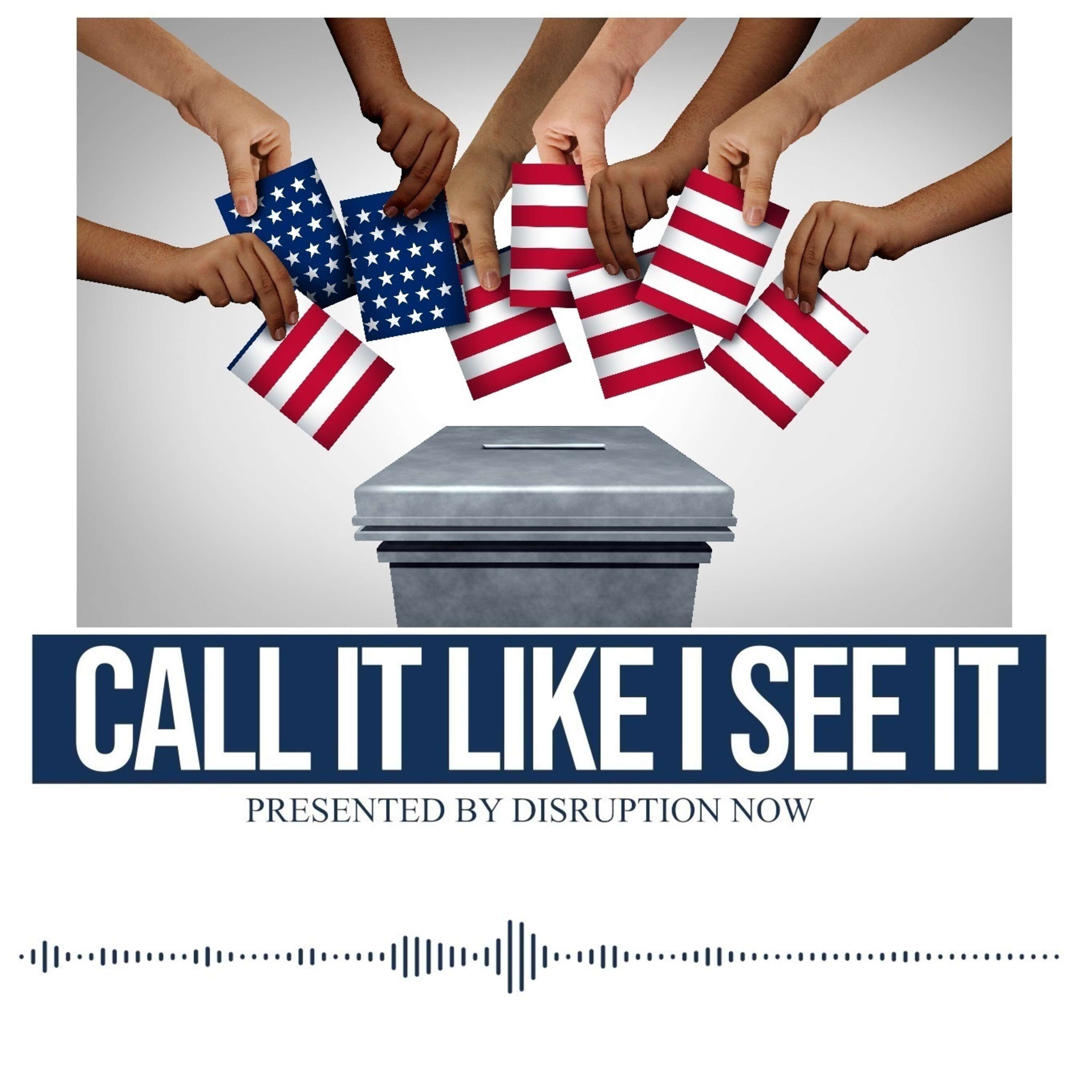
Hello, welcome to Call It Like I See it presented by Disruption Now, I'm James Keys and in this episode of Call It Like I See it, we're going to discuss some takeaways from the 2020 election results, the actual drawn out electoral process that we went through with the 2020 election and what the outcome means moving forward from a governance and just a national harmony standpoint.
Joining me today is a man who operates so smoothly you can find them across the north and down south to Key Largo.
Tunde, Ogunlana Tunde. Are you prepared to take us through how this was all according to your plan?
Wow.
[00:00:53] Speaker B: I wasn't ready for it was all according to my plan, but yes. And for those who know South Florida, I'm offended that you didn't take me down to Key West.
You stopped in the upper Keys. Come on man. What about the middle and lower?
But thank you sir.
I will have a nice property on the Keys one day. So I'll take Key Largo. There you go.
[00:01:12] Speaker A: Also joining me today is a man whose love for his country is stronger than pride, friend of the program, Rick Ellsley. Rick, are you ready to get into some real patriotism today?
[00:01:24] Speaker C: Absolutely, absolutely. Thank you for having me. Again, very excited.
[00:01:27] Speaker A: All right. All right. Now we're recording this on November 8, 2020. And in case you've been under a rock for the past week, the 2020 US election culminated this week with election day, November 3rd. And after counting over 146 million votes, Joe Biden defeated Donald Trump and will become the 46th president of the United States. This also means that Kamala Harris will become the first woman vice president, the first African American vice president and the first Indian American vice president.
So getting right to it, Tunde, what does this election signify to you or what does the choice Americans made mean to you?
[00:02:03] Speaker B: Wow, that's a load of questions. Let me unpack.
Wasn't a landslide victory for Joe Biden like many have predicted, but it was also at the same time it was, it seems, repudiation of Trump as a person and maybe a bit more of Trumpism because that's what stuck me as fascinating that Donald Trump lost the popular vote by a lot, even though a lot of Americans did vote for him. And I think obviously we need to acknowledge that.
I guess he got the second total votes in history right behind Joe Biden. So he did win a lot of votes.
But more important, what it showed me was that there were a lot of Republicans that actually chose not to vote for him at the Top, but they still stayed true to the party at the Senate and the congressional level. So that's what I mean by.
[00:02:55] Speaker A: Yeah. Like, I think Georgia revealed that and Maine revealed that. In particular.
[00:02:59] Speaker B: Yeah, in particular, the Democrats are. And also South Carolina, remember the Harrison versus Graham that was.
[00:03:08] Speaker A: Trump won South Carolina, though more.
[00:03:09] Speaker B: So I was saying Georgia, the Senate race where a lot of people were predicting that that guy Harrison was going to take out Lindsey Graham. And it looked like all that momentum was there, and then Lindsey Graham held. Held his seat and that.
[00:03:23] Speaker A: But that doesn't make your point, though. Your point.
[00:03:24] Speaker B: I see what your point at the
[00:03:26] Speaker A: top down, Biden won Georgia, but the Senate candidates in the Republican Senate candidates in Georgia are ahead. That's going to a runoff, but correct.
[00:03:36] Speaker B: Yeah, no, you're right.
And I was looking at it just from the whole national. But yeah, that's my point. And really, just to finish off, my answer is just that the country is divided.
I think we're divided probably a lot less than we believe. We're being told that we all hate each other, which I think most Americans still have probably 70 to 80% of things in common that we'd like to see happen.
How those things happen, I think is where we get back to traditional political discourse. Right.
[00:04:03] Speaker A: Yeah.
[00:04:04] Speaker B: Tax policy, all that. But let's bring in Rick, though.
[00:04:08] Speaker A: Rick, so what about you, man? What does the election signify to you or just the choice that Americans made? What does that mean to you? Or what stands out?
[00:04:17] Speaker C: I mean, some of the things that Tunde touched on as well. But I think overall, our country voted in a way that repudiated someone who didn't seem to have the country's best interest at heart, based upon what we saw through tweets and through the rejection of science. And I think it was a strong statement. I mean, it was 5 million votes on the popular vote that he won by.
And I think the states that he won were the Midwest. And if he wins Georgia, he also won Arizona. So it's not just East Coast, West Coast. The last election, they said, hey, you know what? This isn't a situation where we have just two coasts. We have a whole country in the middle. And you heard a lot about that over the years that, hey, the Democratic Party needs to get out to the middle of the country. Don't just fly over it going from New York to California.
So I think that from a national standpoint, different regions seem to come in for Biden. And I think overall we probably have. When we look at all of these numbers, we probably have a really good swath of voters from different demographics. I think there was an engagement of a lot of young people, older folks, different blue collar workers. I think we're looking at more people engaged in the process. So whether you voted for Trump or for Biden, one positive out of this and kind of picking up on the last time I was on with the voting is 161 million people voted in this election. That is encouraging. Whatever the outcome was, we had people engaged.
And that, to me, is a great thing, at least getting people educated about the process and getting people involved in the process. And the amount of early votes were huge. And people waited in line very long during election day to make their voice heard. And I'm very encouraged by, I'm very encouraged by that. And I think it's just nice that people actually got out and did it. Whoever they wanted, they got out and they voted. There wasn't.
There's always gonna be apathy, but I don't sense there's gonna be a lot of apathy here. People feel like they, they voted whichever way they voted. Win or lose, they got out there and had an opportunity to do it, and they did.
[00:06:29] Speaker A: Yeah, yeah. I mean, like, that actually was one of my biggest takeaways was just the sheer number of people that voted. You know, like Biden gets 75 million. Trump said a little under 71. So, you know, you are, you are up there in terms of numbers and participation, you know, most votes for a president in history. And so that is, that's progress. Yeah, like you said, building one.
[00:06:50] Speaker B: Well, let me just jump on that, though, just because it's still fascinating to me when I think of those numbers you just mentioned, which is around 145 million Americans, and I think our population is around 330 or so million.
[00:07:03] Speaker A: Yeah, but not everybody's over 18.
[00:07:05] Speaker B: I know. I was gonna say, if you take out people under 18 and probably people that are 100 years old that can't, you know, maybe physically can't vote, and the disabled, the feeble, you know, people sitting in hospital beds, all that, I'm just thinking we probably still have 250 to, you know, 270 million Americans that are eligible to participate. And the fact that this is a landslide record of turnout and it still represents maybe only 60% of the eligible electorate, to me is interesting. It's just interesting that we really don't have that much participation normally, you know, if this is a landslide record of total participation, so it shows.
[00:07:46] Speaker A: But I think it's positive that it was higher.
[00:07:49] Speaker B: I'm just. It's just fascinating to me that this is such a polarizing time and it shows you that, you know, we still don't get 100% participation. That's all. That's just an observation. It's not a opinion either way.
[00:08:00] Speaker A: Well, yeah, I mean, and so I think that, you know, like, the. It's progress that we get more people in. I mean, I know Georgia was very big with that. You saw the work that Stacey Abrams. Abrams has been doing for two years there, you know, and it's almost, you know, in a sense, Georgia flipping blue was almost like Stacey Abrams, last laugh. You know, like the way that she was done in 2018 and then spent two years, like, okay, well, we're just gonna get more people on the rolls. You're not going to. You know, you might have been able to short circuit it in the 2018 election, but not again. So that greater level of urgency and engagement, ideally, is something that doesn't just recede back once Donald Trump is gone. Because the other big takeaway I had from this, I could never get over the fact that there was no Republican platform this year and just that the platform was like, literally, like, formally published by the Republican Party. They said, our platform, we're just gonna recy 2016 and just support the president. And like, that to me was just like, you're not even going through the motions of the whole thing. Like, you're just saying, you know what, we're just a personality cult. And it did show to me that there are limits to that now. There are still many people that are willing to sign up for that.
And that's by definition, if you have a personality cult, so to speak, you're going to have, if it's a effective personality cult, is going to have a lot of people. So that there were still a lot of people that have that. You did see, the ability to demonize the other side is still effective. But the concept of the personality cult and demonizing the other side, this did show it kind of hit a limit it wasn't able to overcome. Now, part of that may have been Biden being very hard to demonize. All the efforts to demonize Biden always had to do with him and somebody else. Biden and his son, or Biden and the squad or Biden and this. You couldn't just demonize Biden directly, but either way, it didn't work.
All the effort went into to demonizing the left. All the effort that went into we have allegiance to Donald Trump. Overall, that stuff did not produce a win. And so that to me was very interesting from this standpoint, that the party decided to go all in on that and that it didn't work, I mean, which was encouraging from the standpoint.
The other thing that I would say that's related to that is just that the resiliency of our system to resist something like that. You know, to resist. We've seen throughout history where charismatic personalities can overwhelm a system and take it over. And our system seemed to have resist our people. You know, you got to credit the people. But our system also seemed to be able to resist that there were so many things, so many checks and balances here and there that even all the efforts that went to take out checks and balances, I still didn't get enough of the checks and balances, took it out.
[00:10:45] Speaker B: Can I go ahead, jump on that?
I've said this before to you in private conversations that I always heard the rhetoric about the desire for limited government by folks like libertarian type of folks. And you read the Federalist Papers and you see the tension between the founding fathers as to how big the government should be or not and all that stuff. And it's funny I said to you, I remember saying that it was ironic that I realized under this administration the benefit of limited government.
And like I was saying that the tanks only rolled down Washington, D.C. because of the fact that governors have to invite the US Military into each state.
[00:11:32] Speaker A: So how you're talking in reference to like when the protests were going.
[00:11:35] Speaker B: Yeah, correct. Back in June. And so like that's when I kind of realized, wow, this, what a great system. We have this kind of constitutional republic with this federal government that also has to deal with states that have rights and then the states have to deal with counties and municipalities within them that also have their own rights and certain things. So it creates such a messiness.
And I think that's what a lot of people get frustrated with and tired of over time.
But it's this beautiful system that protects us from a lot of things. Because I want to say, I was going to say protects us from ourselves and all that, but that's a little bit simplistic. I think it just protects us from a lot of things, including ourselves or potentially forces that we may not realize don't have the long term interest of the country as a whole at heart.
And that's not a statement directed like at Donald Trump personally. It's more of just his presence and the way that he tried to will power as an autocrat.
The system actually held. And I find that interesting because as you're talking about the Republican Party platform from August, from the convention, which was literally, I remember it was in writing, that they have no platform for this year.
[00:12:57] Speaker A: Yeah, it's the craziest thing.
[00:12:59] Speaker B: What I started thinking, as you said, that was here's a party that traditionally has been populated, meaning the Republican Party, with a lot of thoughtful conservatives over the years, and you have some very smart people.
And to see, I thought, how did the party go from being very engaged in foreign policy ideas and domestic policy ideas and all that to four years after the inauguration of the current candidate and leader of the party to go into nothing? And I thought it's a fast transition, but it's not overnight. And if you really slow it down, what we see is the purging of the voices in the Republican Party since 2016 that actually were the ones that added thought and kind of, let me see, texture and meat on the bones.
[00:13:53] Speaker A: Well, you can take that back to eight, though, can't you? Yeah, well, because that was Tea Party, because that purging those thoughtful Republicans. I want to get Rick in on this because we still got to keep moving. What'd you want to say on that, Rick?
[00:14:06] Speaker C: Well, just to pick up where you guys left off about this platform. They just wanted to ride the Trump horse to whatever path it was going to take to the end result that they thought they were going to get. I mean, the arrogance of not having a platform was, to me, terrible. So I'm glad you brought that point up. And, you know, it does go to the cult of personality. I mean, Donald Trump is not unique. I mean, we had Joe McCarthy in the past who fortunately didn't become president. But people tend to forget a lot of the details when they're so caught up in, let's keep these seats in this location, let's keep the presidency, let's keep the Cabinet.
And it doesn't really necessarily matter what we have to say or what the details are. And that's what a platform is. And if you look at the opposite about how they fought this, they tried to paint Joe Biden with the Bernie Sanders brush and say, okay, the Democratic platform has all of these things that are gonna lead to communism and all of these things that are very bad.
And that's an issue.
And I just kind of wanted to say on the cult of personality thing that I listen to a lot of the podcasts, I mean, all the podcasts, obviously, that you guys do and the ones I've been on, and it usually starts With Tunde being sad and me too, I'm being sad, but. But you know something that was nice is that there does seem to be hope and change. And I hate to just borrow that and steal it from the Obama 08 campaign.
[00:15:32] Speaker A: Please borrow that.
That's a good message.
[00:15:36] Speaker C: No, no, I agree. But what I mean is it wasn't just unique to Obama, okay? We're now past the newness of the Obama. It's such a good concept. We have hope for change and there are no two better words than that. So that's a genius.
But that's what I'm thinking of. And I think my hope comes in that with this rejection of that kind of bad behavior, that offensiveness, the off putting that we had from the Donald Trump tweets, and we could spend plenty of shows on all of those. But just in general, this country, from head to toe, left to right, top and bottom.
I believe even though 70 million votes for Donald Trump wants a president who shows some empathy, who inspires us, who's not off putting, who at least attempts to try to bring in a group together to bring us all as one as Americans and not blue, red, white, and to have a respect and an admiration and a compassion for the institution of the presidency and of the White House and the other institutions, not seeking to, you know, ignore a whole institution of government. And I just think it's kind of nice that the demographics in this country all kind of came together and recognized that maybe we like some of Trump's policies, that's why we're gonna vote for some of our local races in the Republican Party, but we don't like what this man or this figure seems to represent. And that is something that this election signified for me. And that's hopeful.
[00:17:14] Speaker A: Yeah, yeah, I mean, that's all that's good. I mean, yeah, it is good that we can strike a more hope tone here. One thing to speak on, I mean, we've mentioned it a couple of times just in terms of the 70 million. 71 million. Almost 71 million at this point. It'll probably cross 71 million at some point.
All changes of direction in this country for the most part, or I guess disputes or arguments, discussions are relatively close. So I mean, I don't think that we should look at necessarily the number of votes that Donald Trump got as the, as some meaning to say that, oh, we're screwed or whatever. I mean, everything. If you would have taken polls of Americans in the 1940s or taken polls of Americans in the 1860s, it would have been people, a substantial millions of people on each side of every issue.
So the trick that Biden's gonna have to do is to figure out a way to bring more people into the fold now that he's won. And how he does that we'll get into actually looking forward here a little bit later on.
But I wanted to ask you guys particularly also to speak about the messiness of the process and how long it took for a winner to be declared in this case. Rick, if you could start us out here, just what was your take on it took from the election day, which was. I spoke of it as a culmination at the beginning because people have been voting for almost a month, depending on where you are.
But election day, end of election day, and Americans generally want their results right away. But we didn't get a. The media didn't call a winner until Saturday, several days later. Your thought on that?
[00:18:46] Speaker C: I'm happy about it. I'll tell you why. I like the fact that a lot of states now, and maybe that's a silver lining with the coronavirus put in place the process for early voting that they didn't have before.
I like that, that engaged more people in it. But it's like laws, you know, and sausages sometimes it's tough to see how it's made. Now we can add to that list elections. You know, you don't necessarily want to see how that happens, but at the end result, I think, you know, even if Trump had had won at this point, I'd be saying the same thing. 161 million votes. Bloomberg News said yesterday was the count as of yesterday, 161 million. I know Tunde not too impressed with that, but I think it's a great thing. And maybe, maybe it does say something about our country, but it's the engagement. And so when you're trying to count all those votes, it's not easy. And I'll say this. There's been a lot of talk you hear in the news about federalizing the election process so that every state has the same voting process. People were talking about swiping a card on a computer because we can do it so easily with every other application. As far as life, we have medical records on our computer. Why can't we just press a button to vote? I would say this. I like the fact that we as a United States, now these are United States, have individual laws for each state on how they conduct their voting process.
To me, that adds a little bit of validity, a little bit of suspense. But mainly a little bit of validity, because what's going to happen if in the next election we have a federalized system, the people who are not part of the party that's in power are going to say the whole federal system is fraud.
It's terrible. And there might be more support for those claims if we have.
[00:20:35] Speaker A: It's easier to manipulate if there are fewer controls that need to be, fewer levers that need to be pulled. Like, the reason it couldn't be manipulated this time is because there's 50 states with 50 different levers that need to be pulled. And that would be very difficult to do.
[00:20:48] Speaker C: I agree. And as Florida is a shining example of we can do it in every state, we made it from the load of the low on how to vote to basically getting our stuff together pretty quickly. So I think it's a necessary evil to kind of answer your question a little bit long way. Cool.
[00:21:04] Speaker A: What about the budget?
[00:21:05] Speaker B: I want to jump in. Yeah. Because it's a great point. And it again, reminds me of how I've, I wouldn't say like my change, my views magically change. Sorry, but that how observing all this has evolved my thinking over and like I said, why it's important to have a divided government. And really, and I agree with Rick, you know, my desire for simplicity and for speed would have me agreeing with a federalized election process. Like, let's just get it clean. Like you said, Florida was fast. And if everyone else could get it done the same day of the election, that's great.
But you're right, my concern over manipulation at any point by any party allows me to see what a better system we have based on what Rick just said, that we are the United States and that each state, though, retains its right to do their things in their own way. And I was gonna say this to, let's say, friends of ours who might be more Democratic leaning listening to this and who felt that, let's say the Russians helped Donald Trump become president in 2016, for example, whether one believes that
[00:22:19] Speaker A: or not, the intelligence community that says that.
[00:22:22] Speaker B: But let me go ahead, keep going. That's what I was going to get at is there's actually no one has said with any credible evidence that the Russians or any foreign power has actually infiltrated our voting system in terms of the infrastructure, machines and all that, in terms of successfully changing votes and all that. Now, the manipulation, like you said, came through social media and more psychological operations, which obviously, you know, I don't know how you stop that. And that's a whole Nother show. Right. But the idea of. To Rick's point, we've got 50 different systems individually that all culminate up to this decision for a president. So that's what I'm saying is that I'm recognizing. And again, we've talked about this too, like the constitution. And our whole system is really an experiment for humans to gather together in a community and fight against our, you know, their own instincts. Right. So my instinct is I just want everything smooth and I don't want anything messy. I don't want to see sausage.
But the reality is that I have to calm down and understand that actually the slowing down of the process and all that and the messiness of it actually makes. Probably ensures that it's harder to cheat.
[00:23:41] Speaker A: Yeah, it makes it more resilient, you know, more.
[00:23:43] Speaker B: That's a great. Yeah, that's a more, you know, to the point way of saying it.
[00:23:47] Speaker A: Well, let me jump in, because that's democracy supposed to be messy. You know, like this is a feature, not a bug, which builds on what you guys have been saying.
Because, like, if you want a smoothly running government, then you need a dictatorship. Dictatorships run relatively smoothly. You know, some people joke, I know my old boss used to say this, that the best form of government actually is the benevolent dictator. The dictator, that is just nice.
But what, somebody's a dictator, you can't require them to be nice anymore. So it's meant as a joke because it's not something you can guarantee if you just put somebody in charge of everything. So democracy is supposed to be messy. People are gonna be arguing, people are gonna be fighting. You gotta count votes. And that's a messy process, counting millions and millions of votes. But that's the system we have, and that has certain benefits. And the distribution of the authority. You have 50 different sovereigns coming together to put together an election here makes it more robust. It makes it harder to infiltrate.
Now, I will say this. There is evidence from the intelligence community that the Russians have accessed different various states, but there's no evidence that they actually changed votes or anything like that.
But the thing to Tunde point, though, if there was one central system they could access, that gives them a big target. If there's 50 of them, it would be very difficult to go access 50 different systems and do all this other stuff. And so it makes it much more difficult to do nefarious things the way we have it distributed like this. And honestly, we can be patient. Just because we're used to immediate gratification is not A virtue. Patience is a virtue. And so in this case, the person, whoever gets elected isn't inaugurated until January.
They don't even do the voting of the electoral college system, I believe until like December. And so taking a week or whatever to count all the votes to make sure it's done right is a really small inconvenience and it does not hurt us at all to be able to wait. Did you want to jump in on that, Rick?
[00:25:58] Speaker C: No, I agree it makes it harder to infiltrate. But I also believe that the buy in from the losing party is very important in the legitimacy of the election because it provides a little bit of immunization against fraud. And it was stolen. If we have Republican legislators in Republican states that were won by a Democratic presidential candidate, but those Republican legislatures and governors made the rules for the voting, it makes it a lot harder to buy into with your hearts and your minds that this was stolen because there's a so many states that could have been involved in this instead of just one central authority. So I agree on the security issue, but I also agree more from an emotional issue and a support.
[00:26:48] Speaker B: I want to jump in on that one because it goes to Rick's point that it's very emotional right now. We're a few days after the election, but I think as time goes, kind of some of the dust will subside. There's always going to be, with any kind of, you know, any of this stuff, there's always going to be a hardcore base of believers, but there's also that larger periphery that once, you know, more evidence comes and things kind of, you know, the emotion starts dissipating. You know, those are the people that will accept the results and move on and help the country move on over time.
One of the things I did want to allude back to, James, in your comments though, was really, I think what we're talking about, if you really extrapolate it out historically, is it's messy because it has to be. And you make a good point, it's really a great point about dictatorships and authoritarian regimes because that is smooth. And if we look back through what do we have, 8,000 years of recorded human history since they were chipping the tablet stones in the Mesopotamian days. I think our experiment, why we call it a great experiment, the United States, maybe the Greek Empire and maybe the Magna Carta, but even the British still have a monarch.
There's not too many examples in human history where you have a thriving democracy, where generally the population is allowed to have a direction and a say into the future of the nation.
[00:28:14] Speaker A: Because it's messy.
[00:28:15] Speaker B: Yeah, exactly. That's what I say. It's a great point that I wanted to reiterate is most of human history, large societies, anything larger than a kibbutz has been governed by a king, some sort of monarch.
That leadership is ruled through blood, through birthright.
One could maybe say the Catholic Church is a version of strong leadership through authoritarianism. So one could say religious leaders, especially more in ancient times.
[00:28:51] Speaker A: I mean, to sum it up, it's either you had the biggest gun or the biggest guy.
[00:28:54] Speaker B: Yeah. You know, or a dictator that was like a warrior. That's it. So it's like. Yeah, it's somebody that wasn't really gonna listen to opposing views. Right. And that's what made it easy, is let's just crush opposing views. So I think that's something that we all have to accept.
Those who were happy with the result of the election and those who weren't. Because I'm gonna guess that most of the people that were very happy about the results of last week's election were very unhappy with the results of the 2016 election. But if you look at what actually happened without the emotion, it's kind of the same thing.
Both elections were decided pretty much by razor thin votes margins in just several key battleground states. And both elections had votes that were being counted days, if not a week after the election took place.
And both elections were kind of finished by the networks calling for the winner, based on information the networks were getting from the individual states that were reporting. And once it gets to a point where it looks like no matter how many votes this person gets, they can't win because we only have so many votes left to count, then they call a winner. So, realistically, those who supported, let's say, Mrs. Clinton as the nominee in 2016, they weren't happy with the results of 2016 and the razor thin margins. Let's say that President Trump won by 10,000 votes in the state of Michigan, which gave him the Electoral College, even though she won the popular vote.
And then today, the supporters of President Trump aren't happy because he lost by razor thin margin and the votes are being counted and all that. So realistically, it's the fans or the supporters of the loser who aren't happy. But if you actually look at it for what it is, it's exactly the same process that just happened.
And I have a lot of people in my life that are very animated on both sides of the spectrum politically in our country. And so I just See, like four years ago was one group that was, oh, it's just stealing and it's fraud and this person should never. And now it's gonna be another group of people that feel like it was stolen and it's fraud. And that's the sad part. To me, now I can say I'm sad, Rick, I'm sorry, but now I'm sad. Okay, we knew it was coming.
Knew it was coming.
[00:31:20] Speaker A: So if anybody is playing, if anybody's playing a drinking game, time to take a shot. Tune day set.
[00:31:25] Speaker B: I said I'm sad. I'm sorry, guys.
[00:31:27] Speaker A: Sorry we kept you waiting this long. But yeah, you could take your shot. But we look back, but I wanna look forward also to see what risks you know, we're concerned about. What do we see what, what vulnerabilities or trends do we see that, you know, that we, that we should be concerned about or that you, you were concerned about or things that need to be addressed? You know, and one of the things I look at with this, I'm very concerned about the trend in our society. Like we've become basically a reality TV society or a pop culture society and less of one in Law and Order. And what I mean by this is that we're so accepting of people saying things without requiring them to prove it or to submit any evidence of it. And so I'm very concerned about this. Like this. I don't know if this is. I asked you guys both this yesterday because I'm just trying to get my head around this. Like, is this a trend that we see or is this because, you know, just the way infotainment, you know, like the explosion of infotainment. But I'm just always shocked about how readily people will make declarations or say things and not even attempt to substantiate it with any evidence. Just say stuff and float it out there and then just run with it. But that's a two part thing because it's also, it's the person that says it and then it's the receivers of that information that aren't saying, okay, well, show me, show me how that, what do you have? What evidence do you have to back that up? And don't even desire it. Like, even if it's somebody I support or something I support, when somebody tells me a quote unquote fact, I then want to see the support of it so that I can go around talking about the fact and then say, hey, and this is how I know that. And so the divorcing of declarations and positions from Any type of substantiations is very concerning to me. I mean, all the way to the conspiracy theories. Now, where used to be if you wanted to start a conspiracy theory, you at least had to put your name on it. Now conspiracy theories are floating around and nobody even knows who's saying the stuff. It's like, it's anonymous.
[00:33:36] Speaker B: His name's Q. Come on. He got a name.
He got a letter.
[00:33:41] Speaker A: He got a letter.
[00:33:41] Speaker B: Yeah, maybe it's Quinlan or Quincy, you know, so nobody.
[00:33:45] Speaker A: So like now you don't even have to put your name on stuff and people will take it and run with it. And so it's just that to me is the biggest concern because I don't know how you can productively have discussions if you can literally just opt out of, like, I can just tell you something, present you with evidence of it, present you with substantiation of it, and you just say, well, no. And I say, okay, well, give me your evidence. And I wonder. I don't need it. What do you mean you don't need evidence? So that to me is the concern, like the evidence free claims, you know, like just across the board. And particularly, you know, I would look at with the traditional media with that less so social media. Just because social media, if you're, if it's just somebody's crazy uncle, that's a little different than actual traditional media doing it. But that to me is a big concern. I don't know if you guys, you know, either one of you guys know, what are you thinking?
[00:34:32] Speaker B: As far as I got somebody. Go ahead.
[00:34:35] Speaker C: First of all, just to pick up everybody's crazy uncle. Sorry. Was in the White House for the last four years. Okay, you walked right into that.
But the problem that is here is, like you've always said through these themes is that it's the accessibility of information and the willingness of people to believe it so quickly. But it's the accessibility of information and I think it's the lack of a strong formal education.
We have not caught up in our schools, I think, to this technology and how it really affects us. And I just want to get back to where that psychology is.
A man hears what he wants to hear and disregards the rest. I mean, it's a great line and a song that I love. Right. But that goes back.
[00:35:15] Speaker A: Well, no, you're an attorney, you're a trial attorney, so you know that better than mine.
[00:35:19] Speaker C: Well, I was gonna say the first thing we learned in the first few weeks of law school is a book written by Benjamin Cardozo. Who was a great Supreme Court justice. And yeah, you remember that. And it was the, I think it was called, the title was like the legal process of ruling. But what they do is they take judges and juries do the same thing. They take the first, you know, three or four minutes of whatever anybody's gonna say and in this case of social media to kind of bring that point. It's the first three or four seconds or the first image and then they find a way to justify it a la QAnon, a la the Pizzagate, a la all of these things that they need to justify what their fear is. Which goes back to my whole neuroscience theory that we talked about before. But I just think it's hard to get away from that because there's so much available information. I don't know in 10 years if they're going to have journalism departments in colleges. And that makes me so sad because journalism is such an important part of what our, of how we run our country, you know, and it has become.
[00:36:20] Speaker A: It's the fourth.
[00:36:21] Speaker C: Exactly. Yeah, exactly. And it's part of it. So, you know, I think there's been.
And that was one of the things that I had noted about signifying. I think this election signified the desire to get back to science and reality and hopefully maybe some middle of the road, you know, journalism so well.
[00:36:39] Speaker A: I mean, it's just at least fact based. I don't mind if you're biased, but just be fact based, just be evidence based, like just back up what you're saying with some type of evidence. And I'm fine with that. Like, I don't think bias is as much of a problem as just willy nilly declarations.
[00:36:55] Speaker C: Let me say one thing, one more thing and I'll stop. There was a commentator on this with all of these Trump lawsuits and I think a judge put it in an order, but I couldn't find it, which was a pleading or a motion without any type of factual basis is just a tweet with a filing fee.
[00:37:14] Speaker A: I saw that too. I saw that.
[00:37:16] Speaker B: That's funny. No, but I think because I'm not as optimistic that this goes away just because we have a change of occupant of the White House type of thing. Because remember, I think the problem with this cult of personality when you have someone like this that's a leader and Trump's not the first person like this in world history. No. But is that everybody forgets kind of the bigger landscape and they just focus on that character. And I think, you know, Trump didn't create where our country is.
He's kind of the symptom. Not. He's a symptom, not a cause.
And I think that, you know, there'll be others to take his place, and the Trump base is still there, and they still will resonate and want someone that fits the mold of what Donald Trump gave him. I mean, that's what I think. That's what I say to my friends that are very partisan on the Democratic side is like, you need to acknowledge that 70 million Americans thought this guy deserved another four years. And so to sit here. And that's where I think, look, this isn't Joe Biden's fault, but I think this morning I woke up and turned the news on to all these reports that the Washington Post now is saying that immediately, like on day one, Joe Biden is gonna reverse every single thing Trump did with executive orders. And I thought, you know what? That's the type of shit. It's not that that's Biden's fault or anything that that happened. But that's where I do criticize the media a bit. Like, we all have a responsibility right now just to kind of chill out.
And, you know, there's a lot of Trump supporters that are not happy about what just happened, and I don't find it productive to kind of poke it in their eye.
First of all, we don't know what Biden's gonna do the day he gets in. There's a lot of reasons why he was elected in. And I know a lot of people that voted Biden in wanna see a lot of these Trump things reversed. The fact he won means we know that that's a fact, and it's probably gonna happen. So to sit here and now have the media start putting it in everyone's eye that voted for Trump that, okay, everything's gonna be overturned right now with an executive order. I mean, that's just. I would say people that didn't wanna see Obama's legacy immediately turned over with executive orders wouldn't have been happy hearing that the day after Trump won in 2016. So I just think this is where I think cooler heads need to prevail at every level. And the leaders of every single. Like you said, the fourth estate, all these different institutions that we have in this country, I think people at the top just need to just say, look, everybody needs to take a deep breath. Let's chill out.
[00:39:50] Speaker A: I mean, to your point, even if that's what he's gonna do, I don't see the benefit of the Reporting, that's
[00:39:53] Speaker B: what I'm saying is that you don't need to say that's what I'm saying. Like I felt that's irresponsible by the Washington Post just to report that. Like, what's the point? Why, why poke it in the eye of 70 million Americans? First of all, like you said, we got 70 days till he takes office. We don't know what the guy's gonna do.
[00:40:09] Speaker C: Right?
[00:40:10] Speaker B: And it's just to me, because what I see on the other side of that, from my friends that are Trump supporters, they're in the ecosystem, they're on the social media.
I had a good friend of mine over yesterday show me on his iPad, on his Facebook feed, certain things.
And again, it's not whether he's wrong or someone else is right and all that, it's perception's reality and we should respect that. There's a large part of this country that for whatever reason, felt that Trump deserved another four years. Whether we personally or people that we know agree with that or not. And I think I'm gonna push back
[00:40:47] Speaker A: on you on that for a second.
[00:40:48] Speaker B: Well, let me just finish this point. All I wanna say is if we're all serious about healing the country, I think all of us, including the Trump supporters, including Biden supporters, we all need to look at each other in the mirror first and just say, okay, to your point, James, am I gonna keep believing everything?
Where do I find myself accountable in this ecosystem of information?
And maybe I wanna believe something, but let me just do a little fact checking or looking a little bit deeper, because one of the things that my friend showed me yesterday was he was complaining that it was a fraudulent, this whole thing, because he was showing a video of some van pulling up somewhere at night and saying that they were dropping off all these ballots, 100,000 ballots in Detroit, and they all went for Biden. And my first thought, I didn't say this because I'm not gonna argue with him, but my first thought was, you know, prove to me that was a truck delivering ballots. Cuz all I see is a truck showing up to a building at night, you know, so for now, not to say it wasn't, but not to say.
[00:41:43] Speaker A: Oh, exactly.
[00:41:44] Speaker B: That's all. Yeah, I don't know if that's illegal or not. I mean, if the Supreme Court said that any ballots that were mailed and postmarked by the election day are allowed, and here we are three days after they could be valid. And then Detroit is a heavily leaning Democratic city.
So all those Three things don't add up to me to be fraudulent, at
[00:42:06] Speaker A: least without more proof.
Provide some proof that that is what you say it is.
[00:42:10] Speaker B: Correct. But that's where I feel like I'm not optimistic immediately after this that it's gonna be Kumbaya, because that stuff is still circulating.
[00:42:18] Speaker A: I agree 100%.
[00:42:19] Speaker B: People still want to hear it. And that's why I feel like, so it's on all of us instead of looking at everyone else saying, oh, we should, everybody should just come together and all that.
You know what? The next time anyone listening to this gets something in their newsfeed like that that's not 100% clear with something that you can say, yeah, this is 100% factual. You need to ask yourself too. I may want this to be true, but I just don't know. I just say that.
[00:42:42] Speaker A: Well, that's actually I wanted to. That's the direction I want to go. Like, I don't know that you can say that 70 million people thought that Trump deserved four more years.
What they did, you know that 70 million people thought that they wanted Trump more than they wanted Biden. And that's my concern.
[00:42:58] Speaker B: That's another way to put it.
[00:42:59] Speaker A: Well, but the distinction though, is that the ecosystem that you referenced there, I think that it's psychological warfare that's being engaged on Americans. Like there is an attempt to keep people, certain people, I guess, constantly enraged and constantly upset and constantly fearful of their fellow Americans.
And until that's dealt with, and I mean, my thought, basically I say all this to say, and I was gonna come with just like, I think we need to figure out a way to punish propagandizing evidence free claims by media organization. Now propagandizing gets into repeatedly saying things over and over again and evidence free claims, meaning you have to substantiate it. This is Rick Goes. Rick just mentioned as far as how journalism is disappearing. Well, part of journalism is sourcing claims. You have to have sourcing for what you're saying. You can't just get out and say stuff. And so I think they're. And I don't know the way of this because I'm not in favor of restricting speech.
But in terms of media, there has to be. And this used to exist, you know, there used to be requirement you would get sued if you went out and said things without any kind of sourcing. And so there has to be a way to figure out a way to. If you're gonna propagandize evidence free claims. Because I do think that's being done. I think I look at the person who is in the ecosystem that is getting all this information as the victim here, that there are forces that want to maintain their attention in the attention economy, the economy that we live in right now. Eyeballs are the most valuable thing. If you can keep somebody's eyeballs, you can make money on them. And the way you do that is, for some people, is to keep them constantly upset.
And that all comes together and creates a system, like you said, Tunde, where there's no reason to be optimistic because it's still profitable to keep people upset. And if you can say whatever you want to keep them upset with, look, there's a van. I can concoct this whole story about this van and support it with nothing and nobody bats an eye. It's like, well, hold on. How can you say all that other stuff with.
[00:45:03] Speaker C: It's worse than that. It's worse than that. The President of the United States will tweet about it and then it will become a legitimate thing that's newsworthy. And that's part of my relief with not having him in the White House is because I just don't think the next president or the president after that is gonna tweet conspiracy theories. And it just. It's so much energy lost and so much argument. Like, look, we're just talking about this now. We could be talking about something else.
[00:45:28] Speaker B: But let me.
[00:45:28] Speaker A: I wanna wrap this up. So if you guys had any other thoughts as far as that.
[00:45:33] Speaker B: Is that. Is that that. Look, it goes back to my point, right, that I think the Republican Party, I don't wanna sit here and say, oh, they gotta do soul searching and all that. Obviously it's a political party that's made up of people. But what I will say is the lack of a healthy dialogue and a robust, healthy, rational, conservative viewpoint to push back against liberal viewpoints.
The lack of that is actually detrimental for the good functioning of our society. So that's really. I think when we talk about the Republican Party had no platform and that, like Rick's comments about, you know, the conspiracy theories tweeted by the President. I mean, I know a lot of his supporters think, oh, yeah, I don't like the tweets and it's a joke. But, you know, three weeks or four weeks ago, he tweeted out, basically, the Navy SEALs didn't kill bin Laden. You know, retweeted some. And I'm thinking like, hold on, this is the commander in Chief.
Yeah, tweeting a conspiracy theory about basically, like our Version of the Knights Templar. You know, like our top.
Our top, top military.
You know, the guys that do the Crusades for us. Right. I mean, the Navy Seals are our top top guys. And the commander and the commander in chief basically attack them.
[00:46:50] Speaker A: Yeah.
[00:46:50] Speaker B: And say they didn't do something that they did.
[00:46:53] Speaker A: These guys, you know what?
[00:46:54] Speaker B: Like, that's crazy for our lifetime. Guys in our 40s. You know, bin Laden is the biggest boogeyman we've had in the last 40 years of American kind of history. And, you know, that's what I mean is that that's not healthy for our society. And that's why it's not a partisan thing. I'm saying we need a healthy and robust conservative dialogue.
[00:47:15] Speaker A: No, that's 100% right. Him tweeting out conspiracy.
[00:47:19] Speaker B: No, that's not the Republican Party to get serious again.
[00:47:21] Speaker C: That's right.
[00:47:22] Speaker B: Thought about bringing people in here who can give us something more than this.
[00:47:26] Speaker A: Him tweeting out conspiracies doesn't help the country.
I'm a big believer in what you just said. We need conservatives to look at liberal ideas, progressive ideas, and pick them apart on the merits legitimately. Not just to demonize them, but to say, hey, Obamacare would be better right now if he got legitimate conservative feedback saying, no, actually, if you're doing it like this, this is gonna be too wasteful. We should do it like this. Like, if you got legitimate conservative feedback. A Green New Deal. If we do a Green New Deal and it has no feedback from a conservative mindset, that probably is not gonna be as good as if we got real legitimate. Hey, I don't really like this, but if you guys are gonna do this, you need. Look, this part is problem. This part is a problem like good faith consideration. Because the thing is. And this is just a human thing, and you know, Rick and I are very intimate with this as far as just being attorneys, is that generally speaking, you cannot see the fallacies in your own arguments that. Well, you know, you need someone else to point out the fallacies in your own arguments. Oftentimes, just the way our brains work. We all have confirmation bias. And so we need both sides to participate in actual productive governance. Otherwise we go out of whack. Go ahead, Rick. Everybody get their final thoughts in.
[00:48:39] Speaker C: Couple benefits to that. One is there's more buy in in the ultimate result.
[00:48:43] Speaker A: Very true.
[00:48:43] Speaker C: If the Senate stays Republican and you've got a Democratic White House, you know, and you got your Supreme Court. But, you know, people buy into that because they've had a say, and they feel like their side has had a say at the highest levels.
[00:48:54] Speaker B: Yeah.
[00:48:55] Speaker A: So. All right, Tunde, any final thoughts before we wrap this up?
[00:48:57] Speaker B: No, this is. I said it all. I'll leave it on the floor. Just, you know, looking forward to, you know, more. More. More of the same, in a sense. Right. Change. And then we're gonna. We're gonna have some surprises, I'm sure. And nothing. No straight line to. To the finish here. So. No, no look forward to next time.
[00:49:16] Speaker A: But, yeah, definitely. It was interesting times, man. Interesting times. You know, we appreciate the audience for joining us as we kind of looked at this from several different angles, you know. Until next time, I'm James Keys.
[00:49:27] Speaker B: I'm Tunde Gana.
[00:49:29] Speaker C: Rick Elle.
[00:49:30] Speaker A: All right, subscribe, you know, to the podcast. Rate us, tell us what you think, review, and we'll talk to you next time.